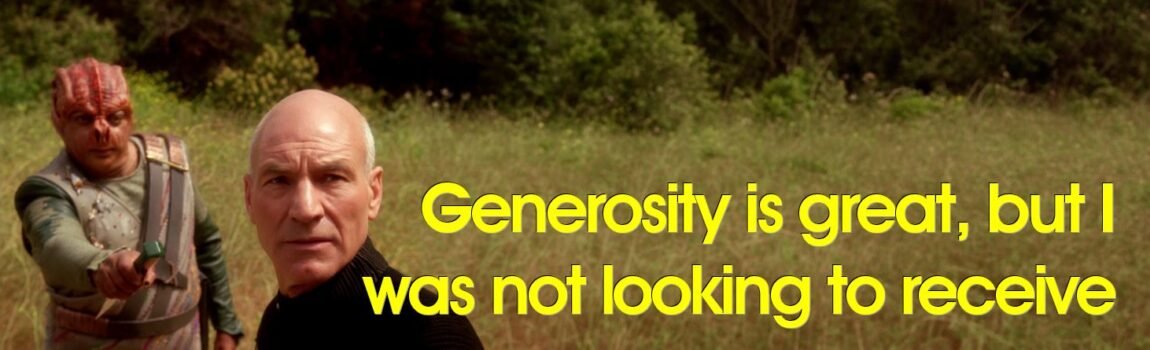

Don’t think I’m being ungrateful. I’m not. I’m happy for your friendship. I’m happy with all I have. I was looking for something…more intangible: your viewpoints, your opinions, your company in a conversation and shared moments. And departing with that would leave a greater impression on me than anything material. I have had many exchanges like this.
My daughter and I have been in very similar situations. In her case, she can already sense an imminent break up with her boyfriend. She felt the interaction to be lacking. She felt she was putting in more effort not only into conversations, but mental energy. It felt like she was going through the motions and the boyfriend simply ‘showed up’ but was mentally absent. There was no original though. No reciprocity. It became work. A dinner hosted by her boyfriend’s mother was also unfulfilling. The meal was great and the parents were lovely. And while she left with a present, material gifts do not fill the void of emotional connection she wanted with her boyfriend. That was the second last time she saw him.
For me, I look for stimulating conversation. I was taken out for dinner by someone I had recently met and we were joined by a small group who knew each other well, so I was the odd man out. I sat next to my friend to my right and to my left, a relatively young coder. I asked what he codes and on which platform. He said he was a programmer for medical devices. He explained that his job was part tech and part FDA compliance officer. The conversation quickly devolved into advancement in tech, drug interaction simulations using AI models and the future of synthetic-organic integration at an atomic level. It went very nerdy very quickly. I drew upon my organic chemistry from my uni days and was surprised I was able to lightly carry on with this esoteric conversation. He laughed and said that for most people, the trauma of learning organic chemistry is permanent brain damage. We laughed so much I had almost forgotten about my hostess to the right!

Nothing material will ever replace the intangible.
I, more than my daughter, have realized that in this age of self-driving cars, drone deliveries and on-demand AI solutions, technology has created massive connectivity in an age of social disconnectedness. The irony is that the more virtually connected we are with total strangers halfway around the planet, the less intimacy we feel with those we are closest to. It’s like the wider we sprinkle pixie-dust, the more diminished the magic becomes.
Call me old school but I still long to pick up the phone to talk to someone rather than engage in endless chats. For me, the former is more meaningful because it is synchronous. With a call, I can hear not just the words, but the pitch, the intonation and of course the compassion in the voice. Sometimes I can even hear their facial expressions! For the latter, I can’t even italicize my often wrongly autocorrected SMSes!!!
I guess for me, and as my daughter is realizing, the medium is not the message. The intent of the message and its authenticity is the actual gem. Its delivery mechanism has increasingly adulterated and even diluted the meaning and potency of the message. Nothing material will ever replace the intangible.
My goal is not to reach a hundred friends giving me a thousand likes from a million miles away. One genuine interaction will do just fine.